
Acupuncture significantly restores ovarian endocrine and vascular function in polycystic ovary syndrome (PCOS) through neuromodulation of the hypothalamic-pituitary-ovarian (HPO) axis [1]. Evidence shows that acupuncture regulates key hypothalamic neuropeptides—kisspeptin, neuropeptide Y (NPY), and dynorphin (DYN)—and neurotransmitters such as γ-aminobutyric acid (GABA), serotonin (5-HT), dopamine, and glutamate, thereby normalizing gonadotropin release, sex hormone ratios, and ovarian morphology [1].
The findings of this research identify acupuncture points that align across traditional practice, modern clinical application, and contemporary scientific investigation. While the review is highly technical, its value is in confirming the continued clinical effectiveness of these acupoints for acupuncture patients. The points validated by the study will be familiar to licensed acupuncturists, though a few present particularly intriguing and noteworthy selections.
Electroacupuncture at Guanyuan (CV4), Zigong (EX-CA1), Qihai (CV6), Zusanli (ST36), and Sanyinjiao (SP6) increases serum estradiol (E2) and follicle-stimulating hormone (FSH) while lowering luteinizing hormone (LH) and testosterone, producing normalization of the LH/FSH ratio [1]. Electroacupuncture at ST29 (Guilai) and SP6 raised progesterone and E2 while decreasing anti-Müllerian hormone (AMH), the free androgen index, and fasting insulin levels, demonstrating improved ovarian sensitivity to gonadotropins [1]. Acupuncture acts through activation of the Kiss1–GPR54 signaling pathway in the hypothalamus, enhancing gonadotropin-releasing hormone (GnRH) pulsatility and promoting the secretion of FSH and LH [1]. Up-regulation of Kiss1 and GnRH mRNA after CV4 stimulation correlated with increased E2 and normalized ovarian structure in PCOS rats [1]. In parallel, electroacupuncture down-regulated hypothalamic NPY mRNA and NPY2 receptor expression, reducing sympathetic hyperactivity and cystic ovarian morphology [1].
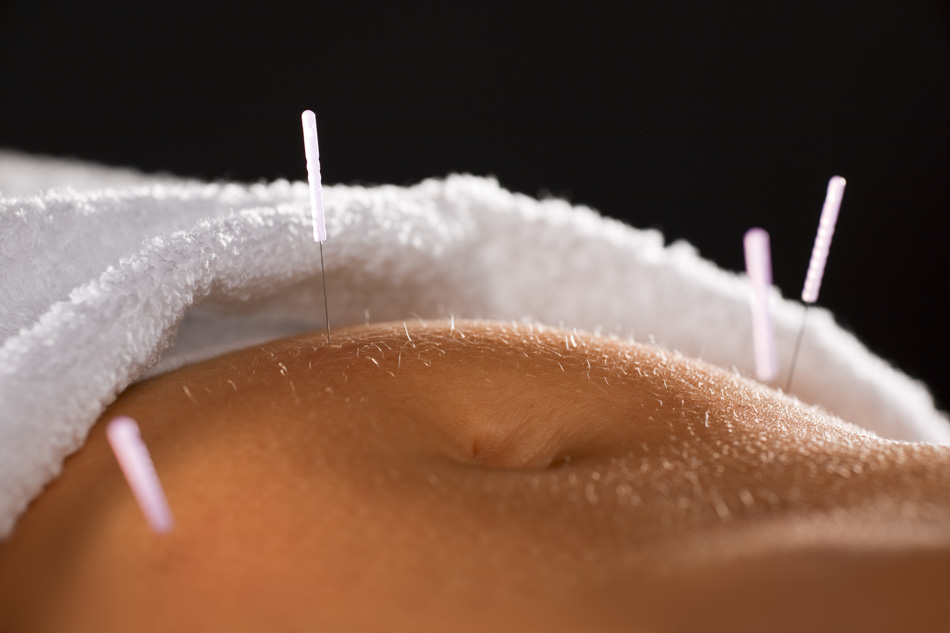
Many protocols evaluated in the review used sterile 0.25 mm × 25–40 mm stainless steel needles, inserted perpendicularly to depths of 2–3 cun until deqi was achieved. Low-frequency electroacupuncture (2 Hz, continuous wave) was applied for 20–30 minutes, daily or every other day for 2–4 weeks [1]. A 16-week randomized controlled trial in PCOS patients using electroacupuncture at CV3–CV6 found elevated norepinephrine (NE) and reduced 5-HT, suggesting re-balancing of both emotional state and HPO neuroendocrine regulation [1]. Manual acupuncture at CV4, SP6, and Zigong reduced LH and AMH while elevating E2, demonstrating comparable results with non-electrical stimulation when proper intensity was maintained [1].
Neuroanatomical tracing reveals that acupuncture’s ovarian effects depend on segmental innervation spanning T10–L2 and L6–S2 spinal levels [1]. Signals from CV4 primarily project to the L2 dorsal root ganglion, linking the lower abdominal acupoints with ovarian sympathetic output. Acupoints SP6 and ST36 correspond to L2–S3, creating overlapping neural pathways regulating the HPO axis [1]. The superior ovarian nerve (SON) mediates electroacupuncture-induced increases in ovarian blood flow and mean arterial pressure. After SON transection, these hemodynamic responses disappear, confirming a reflex origin through the sympathetic pathway [1]. Electroacupuncture also influences the vagus nerve, activating α7 nicotinic acetylcholine receptors on macrophages and suppressing NF-κB inflammatory signaling, thereby improving insulin resistance and inflammatory markers in PCOS [1].
Functional MRI demonstrates that electroacupuncture modifies cortical and hypothalamic connectivity in ovarian disorders. Patients with diminished ovarian reserve exhibited increased amplitude of low-frequency fluctuations in the superior and middle frontal gyri and improved connectivity between these frontal regions and the lingual gyrus after acupuncture [1]. In ovariectomized rats, electroacupuncture at CV4 activated Fos-positive neurons in the arcuate nucleus (ARC) and paraventricular nucleus (PVN), regions responsible for GnRH, oxytocin, and corticotropin-releasing hormone secretion [1]. These findings indicate that acupuncture re-establishes neuroendocrine rhythm via hypothalamic and cortical modulation [1].
Electroacupuncture increases ovarian and plasma β-endorphin (β-EP) levels, enhancing LH secretion and modulating progesterone production [1]. Transcriptomic sequencing of the anterior ventral periventricular nucleus showed that electroacupuncture up-regulated genes related to glutamate transport (Slc17a6) and GABA synthesis (Gad2) while promoting Kiss1 expression, collectively restoring the pre-ovulatory LH surge [1]. Human data show that acupuncture reduces circulating 5-HT and GABA while increasing NE, reflecting a net excitatory balance that facilitates GnRH pulsatility [1].
Locally, acupuncture at reproductive points like CV4 and SP6 induces reformation of collagen fibers, triggering mechanical signals that activate A- and C-fiber afferents [1]. These impulses lead to mast-cell degranulation, releasing substance P (SP), calcitonin gene-related peptide (CGRP), and up-regulating vanilloid receptor subtype 1 (VR1) in the dermis and subcutaneous tissue [1]. Such local neurochemical events enhance microcirculation and initiate the afferent signaling cascade responsible for ovarian regulation [1].
Clinical studies combining acupuncture with ovulation-inducing agents show improved reproductive outcomes. Electroacupuncture used adjunctively with clomiphene citrate reduced the incidence of luteinized unruptured follicle syndrome (LUFS) and ovarian hyperstimulation syndrome (OHSS), while alleviating side effects such as nausea, headache, and dermatitis [1]. In in-vitro fertilization and embryo-transfer (IVF-ET) patients with recurrent implantation failure, electroacupuncture at CV4, CV3, CV6, KD12, BL23, ST36, SP6, and LV3, combined with GnRH analogs, significantly increased pregnancy rates [1]. Collectively, these data demonstrate that acupuncture’s integrated modulation of hypothalamic neuropeptides, spinal autonomic outflow, and ovarian perfusion can reverse endocrine imbalance and improve fertility outcomes in PCOS [1].
The Shandong University research underscores acupuncture’s multi-layered neuroendocrine regulation of PCOS pathology. Through orchestrated modulation of kisspeptin-GnRH-LH/FSH signaling, autonomic innervation, and ovarian microvascular dynamics, acupuncture restores endocrine homeostasis and promotes ovulation without pharmacologic toxicity. This mechanistic clarity reinforces acupuncture’s evidence-based role in reproductive endocrinology and provides a model for integrative management of ovarian dysfunction [1].
Source:
[1] Yu Bu et al., “Acupuncture and the HPO Axis: A Review of Neuroendocrine Mechanisms With Implications for Ovarian Function,” Journal of Integrative Neuroscience 24, no. 10 (2025): 39451.
{loadposition cta204}
